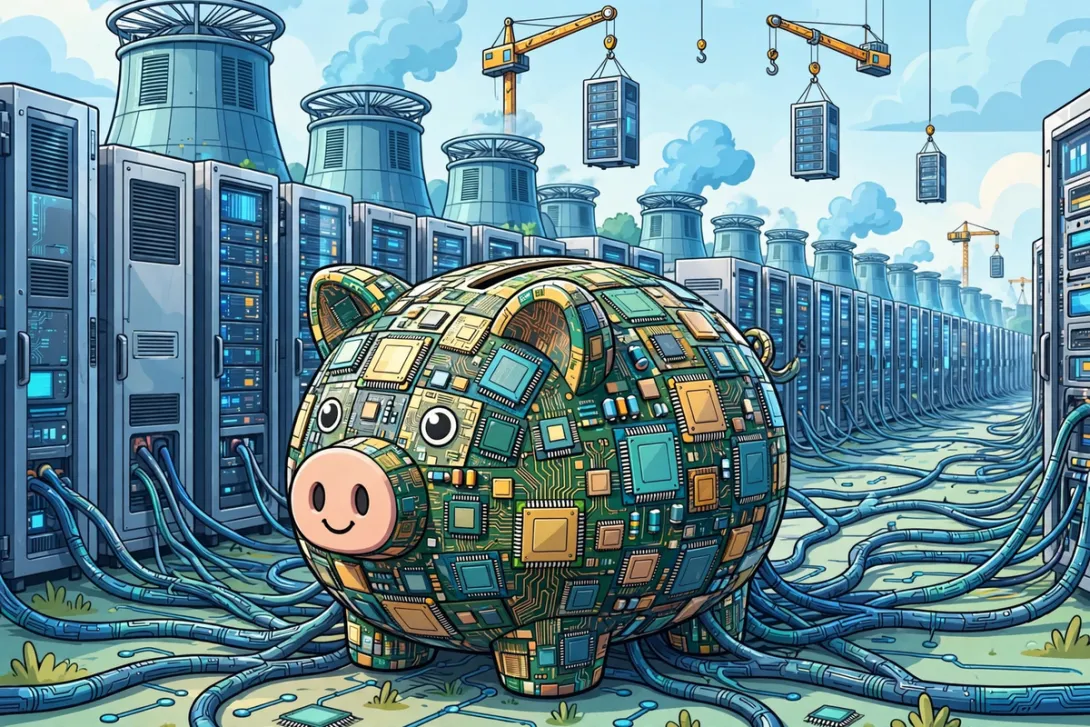
Broadcom chief executive Hock Tan thinks the AI boom's new limiting factor is not silicon. Speaking at a panel in Singapore on Monday, Tan said capital — not wafer or memory shortages — will be the biggest constraint on AI development as the industry pushes forward. The company, he said, is working through its wafer and memory shortages. The harder problem, increasingly, is paying for what comes next.
It is a notable shift in where the industry's pressure points sit. For the past two years, the conversation has been dominated by supply: not enough advanced chips, not enough high-bandwidth memory, not enough wafer capacity at the foundries. Tan's framing suggests those supply constraints are loosening — and being replaced by a financial one. Building and expanding AI systems costs more each year, and the returns can take years to materialize.
The comment lands at a moment when the scale of AI spending has become staggering. Hyperscalers and frontier labs are pouring hundreds of billions of dollars into data centers — the buildings, the compute, the networking gear — before those investments produce a dollar of revenue. Many are borrowing to fund the buildout, and investors are watching more closely than they were a year ago. They want to see a path to profit, steady cash flow, and a clear plan to earn the spending back.
Tan did offer a reason for optimism. He pointed to Anthropic and OpenAI, saying the frontier labs have shown they can generate significant revenue from the latest models deployed for AI personal assistants. It is the industry's core bet in a sentence: if the models produce real, paying demand, the capital intensity of the buildout can be justified. The question is whether that revenue ramps fast enough to keep the financing flowing.
Broadcom sits at an interesting vantage point on this question. The company makes custom AI chips and networking equipment that large data centers are built with — its customers are the very companies spending the money. Demand for those products, Tan said, remains strong. But his message was that even a chipmaker with a full order book is constrained by something more basic: somebody has to finance the construction.
The dynamic mirrors what happened in earlier infrastructure waves. Telecom fiber in the late 1990s, cloud data centers in the 2010s — in each case, the physical capacity eventually arrived, and the companies that overbuilt or overborrowed did not always survive. The AI buildout is bigger and faster than either, which is why the funding question matters more than usual. Data centers need power, land, finished buildings, and long construction timelines. A financing hiccup can stall a project even when the chips are sitting ready.
What happens next will show up in two places. First, in big tech earnings, where investors will be grading whether AI revenue is catching up to AI capital spending. Second, in the financing markets themselves — debt terms, credit lines, and whether the AI trade can keep absorbing the sums it demands. Tan's remarks do not predict either outcome. But they do name the variable to watch: not whether the industry can build the machines, but whether it can afford to keep building them.