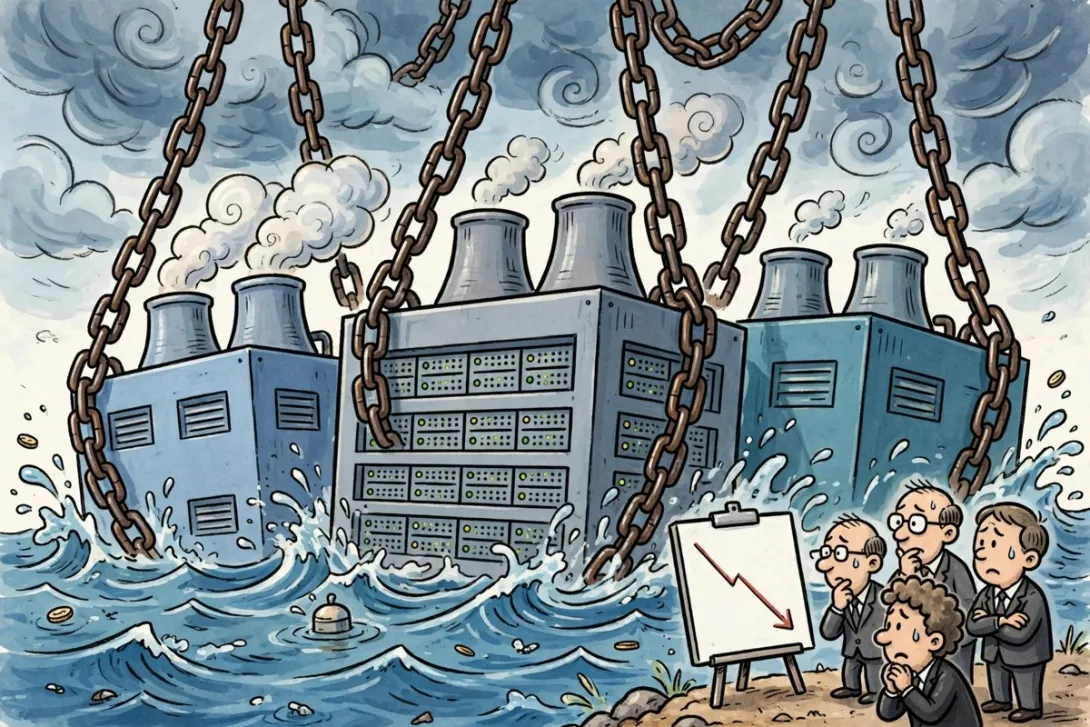
The bill for the artificial intelligence buildout got more expensive on Wednesday, and investors noticed. Shares of debt-heavy AI infrastructure companies tumbled as the prospect of higher U.S. interest rates revived a basic question about the boom: how much return will all of this borrowed money actually produce?
The selling was steepest among the so-called neocloud firms. Nebius fell 15.1 percent and CoreWeave dropped 9.5 percent, according to Reuters. CoreWeave is now on course to lose about a quarter of its value this month, while Nebius is set to erase almost 20 percent. Data center operators were hit as well, with Applied Digital down 8.8 percent and IREN down 9.9 percent. Oracle, the debt-laden hyperscaler at the center of several large AI deals, fell 7.2 percent, and most of its dollar bonds declined too.
The pressure spread to the companies that sell the hardware. AI server makers Dell and HPE dropped 10.3 percent and 6.4 percent respectively after Barclays downgraded both stocks to equal-weight from overweight. In its note, the bank said valuations had run ahead of the evidence and that it does not yet see a meaningful AI inflection in the results.
The trigger was interest rates. Hot consumer price data raised the prospect of a second Federal Reserve rate hike as soon as this month. The 10-year Treasury yield climbed 3.6 basis points and the two-year yield jumped 7.2 basis points. For most industries, moves like that are background noise. For AI infrastructure, they go straight to the business model, because data centers and large orders of AI chips are routinely financed with borrowed money. Higher rates mean higher borrowing costs on every new facility and every new cluster.
Credit markets told the same story. The cost of insuring debt against default for some AI companies, including Oracle and CoreWeave, surged to record highs, according to S&P Global Market Intelligence data cited by Reuters. As Bokeh Capital Partners chief investment officer Kim Forrest put it, “Investors are questioning whether the AI buildout will generate the returns that were expected.”
None of this means demand for AI computing has disappeared. The same companies that fell on Wednesday had rallied earlier this year on genuine optimism about orders, capacity deals, and enterprise adoption. What changed is the math around financing. A buildout funded with cheap debt can tolerate slow, uncertain returns. The same buildout funded at higher rates needs revenue to arrive sooner and in larger amounts, and it leaves far less room for delays in construction, power, or customer spending.
That is why a rate story became an AI story so quickly. The industry’s next phase will be judged less on announced capacity and more on whether the facilities already being built fill up, generate cash, and justify the debt taken on to create them. Until investors see more of that evidence, companies carrying the heaviest borrowing for the buildout are likely to remain the most exposed whenever rate expectations move against them.